

Something from Nothing
On creation ex nihilo, writerly hubris, and the pleasures of making things

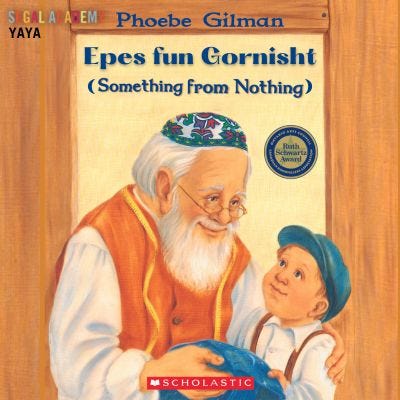
One of my favorite children’s books is Something from Nothing by Phoebe Gilman. Joseph is a young boy whose family lives behind the family tailoring business. When Joseph is born, his grandfather sews him a blanket, which he brings everywhere until it’s tattered and torn. His mother says it’s time to throw it out, but Joseph brings it to his grandfather who salvages the good cloth to make a new smaller item. Each time his mother says it’s time to throw it out, Joseph’s grandfather says, “There’s just enough material here to make…” a vest, then a tie, then a handkerchief, and finally a button. The crisis occurs when the button pops off and is lost. His mother tells Joseph, “Even your grandfather can’t make something from nothing.”
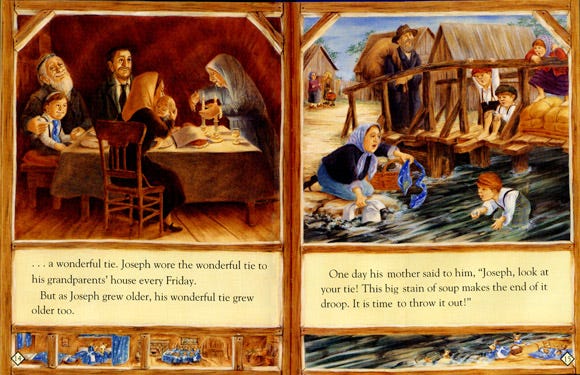
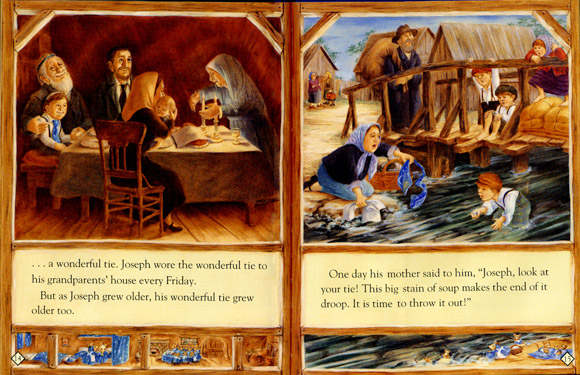
The next day at school, Joseph looks at his paper, picks up his pen, and says, “There’s just enough material here to make… a wonderful story.” The lost button was the last remnant of his baby blanket, and Joseph turns that absence into a story that can endure.
I read this story a lot as a babysitter and a big sister. I loved it. And I also had this nagging feeling that the ending, while happy, didn’t match the title. Joseph didn’t make something from nothing. Joseph needed paper and pen, and he needed those experiences with his grandfather’s tailoring to have material (however immaterial those memories were) for his story.
This wasn’t real creation ex nihilo, the way God created the entire world out of nothing. Creatio ex nihilo was first articulated in Judaism around 100 AD, in opposition to the creatio ex materia of the Greek philosophers.1 The notion of creatio ex materia is more compatible with our knowledge of particles and matter and cells and atoms. Creation ex materia is how we bake a cake (batter + heat). It’s how we make a birdhouse (wood + nails). It’s how we make a baby (egg + sperm + nine months of food).
Why do writers like to say that writing makes us like God? “In the beginning was the Word, and the Word was with God, and the Word was God,” says John 1:1. A university chaplain once told me, “Writers love that verse.” Is that because we see ourselves there at the beginning of the universe, continuing the work of the Most High?
Calling Joseph’s story Something from Nothing seemed to me like yet another writer attaching divine endorsement to their work, kind of like literary critics who find that the solution for existential dread or solitude or social problems is… literature. Perhaps these critics should take to heart the lesson of Ecclesiastes: “Of making many books there is no end, and much study is a weariness of the flesh.” Better to live piously according to the commandments than to get tangled up in bookish debates, says King Solomon (or perhaps an editor adding moralizing commentary).
Phoebe Gilman gets off the hook for solipsism though: her book has its origin in Yiddish folklore, a song known as Epes fun gornisht (Something from Nothing) or Hob Ikh mir a mantl (Make me a coat). Orally transmitted folktales and songs are immaterial, all memory and voice and repetition. Sure there’s material (the dough of all creative output), but unless we’re real purists, folklore sort of is creation ex nihilo, ephemeral culture that slips through the records and archives because it leaves no trace of production process or product.

Writing on the other hand is material: dead trees, plastic pens, half used notebooks, laptops built for obsolescence, cloud resources, printing factories and shipping containers. “Oh look, I made something out of nothing!” I might think as I post this Substack. My carbon footprint would beg to differ: I made this post out of breakfast, summer camp, a bottomless $1.70 McDonald’s coffee, and more carbon emissions than if I’d outsourced this writing to AI, according to Nature.2
But why am I sitting here puncturing the sacred canopies of divine creation and human creativity? A few highway exits from where I am writing sits the BAPS Swaminarayan Akshardham mandir. One of the largest Hindu temples in the world burst out of a barren New Jersey landscape between 2015 and 2023.


In the quantum realm, something can come from nothing. (For the first time, it was proven that a particle can emerge without a collision or precursor particles, through electrogmagnetic fields and the Schwanger effect.)
The New Jersey mandir was creatio ex materia, with stone shipped from across the world. The fact that the mandir was made with already existing materials doesn’t really take away from my admiration for this globe-spanning community and their colossal endeavor.
Maybe we need to get away from our obsession with parts and provenance. I grew up with the Canada Food Guide to Healthy Eating which dwelt on the ingredients, how they were processed, and allocations of plate space by food type. Then in the 2010s, the Brazilian Food Guide made waves by emphasizing how we eat over what we eat: eat together in a calm environment, and share the work of preparation and clean up.3
Writers can take a lesson from the Brazilian Food Guide: you don’t have to claim you made something out of nothing for writing to be special. After all, you can enjoy a dinner party even if the dishes aren’t made from scratch.
Paul Copan and William Lane Craig, Creation Out of Nothing: A Biblical, Philosophical, and Scientific Exploration. Grand Rapids MI: Baker Academic, 2004. 96.
Tomlinson, B., Black, R.W., Patterson, D.J. et al. The carbon emissions of writing and illustrating are lower for AI than for humans. Sci Rep 14, 3732 (2024). https://doi.org/10.1038/s41598-024-54271-x
2015 Guidelines for the Brazilian Population. See page 97 on Eating in Company. https://bvsms.saude.gov.br/bvs/publicacoes/dietary_guidelines_brazilian_population.pdf